Barbell back squat
The back squat is the lift people argue about most and record worst. Depth, bar position and stance all change what you are actually training, which means two lifters writing "squat 225" in a notebook can be doing quite different exercises. Here is what the movement trains, what to decide before you load the bar, and how to keep a record that still means something in three months.
Updated September 2026
- Equipment
- Barbell
- Primary
- Quadriceps
- Secondary
- Calves, Glutes, Hamstrings, Lower back
- Level
- Beginner
How to do it
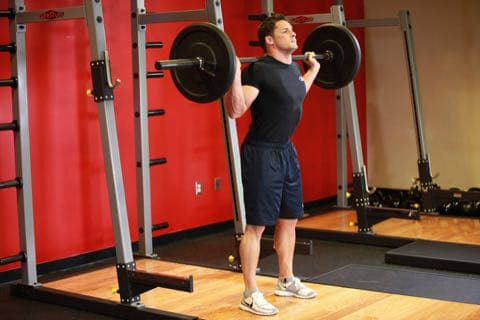
- This exercise is best performed inside a squat rack for safety purposes. To begin, first set the bar on a rack to just below shoulder level. Once the correct height is chosen and the bar is loaded, step under the bar and place the back of your shoulders (slightly below the neck) across it.
- Hold on to the bar using both arms at each side and lift it off the rack by first pushing with your legs and at the same time straightening your torso.
- Step away from the rack and position your legs using a shoulder width medium stance with the toes slightly pointed out. Keep your head up at all times and also maintain a straight back. This will be your starting position. (Note: For the purposes of this discussion we will use the medium stance described above which targets overall development; however you can choose any of the three stances discussed in the foot stances section).
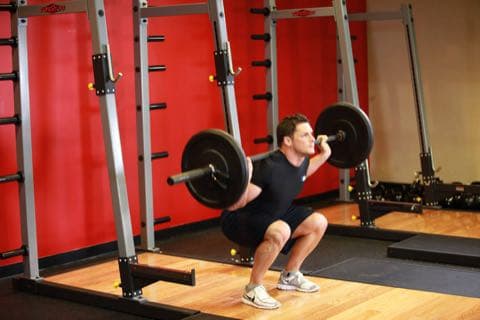
- Begin to slowly lower the bar by bending the knees and hips as you maintain a straight posture with the head up. Continue down until the angle between the upper leg and the calves becomes slightly less than 90-degrees. Inhale as you perform this portion of the movement. Tip: If you performed the exercise correctly, the front of the knees should make an imaginary straight line with the toes that is perpendicular to the front. If your knees are past that imaginary line (if they are past your toes) then you are placing undue stress on the knee and the exercise has been performed incorrectly.
- Begin to raise the bar as you exhale by pushing the floor with the heel of your foot as you straighten the legs again and go back to the starting position.
- Repeat for the recommended amount of repetitions.
Instructions from free-exercise-db, public domain — the same text the app shows on this exercise.
Saying it out loud
Any of these logs a set of barbell back squat in SayLift. Say the whole session in one go if you want — weights, reps and sets in whatever order they come out.
- “Squat, five sets of five at 225”
- “Back squat 185 for 8, 8 and 7”
- “Squats 275 triple, then 245 for 5”
- “Barbell squat three by ten at 135”
High bar, low bar, and why your log should say which
The bar sitting on your traps and the bar sitting across your rear delts are two different lifts. High bar keeps the torso more upright and loads the quads harder; low bar lets you lean further forward, shortens the range slightly and moves work to the hips and posterior chain. Most people can low-bar squat more weight, which is why powerlifters use it and why comparing the two numbers tells you nothing.
Pick one and note it. A year of squat numbers where the bar position drifted is a year of data you cannot draw a line through.
SayLift logs your whole workout from one spoken sentence. iPhone only, 873 exercises built in, 3 days free then $49.99 a year.
Start the free trialDepth, honestly
The useful standard is hip crease below the top of the knee. Above that and you are training a shorter, easier movement, which is fine as a choice and a problem when it happens quietly because the weight got heavy.
Depth is the first thing to go as a set gets hard, and it is invisible to your own log. If your squat is climbing fast while the rep quality drops, the number in your history is not measuring what you think. Film a set occasionally, or squat to a consistent target.
- Knees track over the toes, not inside them. Caving in under load is a cue to drop the weight, not to push through.
- Brace before you descend: big breath into the belly, hold it, and keep it until you are back up.
- Same stance every set. Changing your foot width mid-session makes the session unloggable.
What to log
Weight, reps and set count for each working set. If you squat both high bar and low bar, they are separate exercises in the log, not one exercise with a note.
Squats are also the lift where logging between sets is least appealing, because you are out of breath and the rest is short. Saying the set out loud into a phone takes about four seconds, and SayLift was built around that specific moment.
Frequently asked questions
How deep should I squat?
Hip crease below the top of the knee, as a working definition. Going deeper than that is fine if your hips and ankles allow it without your lower back rounding; going shallower is a different exercise and should be logged as one.
Should I squat high bar or low bar?
High bar if you want more quad work and a more upright position, low bar if you want to move the most weight. Either is fine. Switching between them without recording which is not.
How often should I squat?
Twice a week works for most people who are not competing. Squats cost more recovery than most lifts, so extra frequency usually needs volume taken out of somewhere else.
Stop typing between sets
Say what you lifted. SayLift writes down every set, rep and weight, then tells you what to lift next time. iPhone only, 3 days free then $49.99 a year.
Download on the App Store
Reading this on a laptop? Scan to install.