Barbell hip thrust
The hip thrust loads the glutes harder than any other movement and is the lift people most often abandon because the setup is fiddly. It is also the fastest-progressing lift most lifters have, which makes an accurate log unusually valuable: the weight can move week to week in a way a squat never will.
Updated September 2026
- Equipment
- Barbell
- Primary
- Glutes
- Secondary
- Calves, Hamstrings
- Level
- Intermediate
How to do it
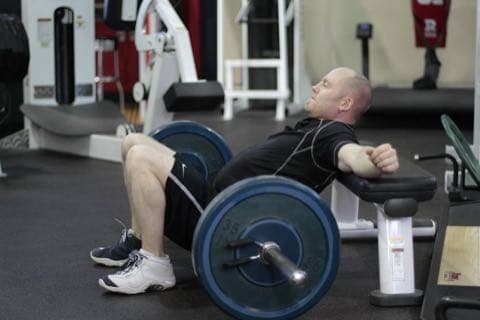
- Begin seated on the ground with a bench directly behind you. Have a loaded barbell over your legs. Using a fat bar or having a pad on the bar can greatly reduce the discomfort caused by this exercise.
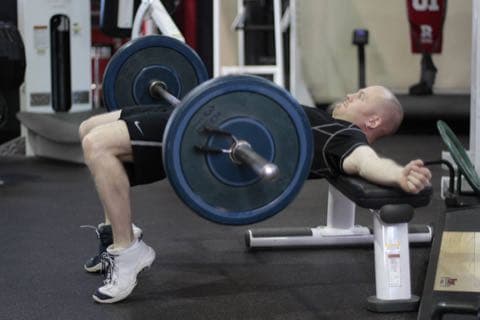
- Roll the bar so that it is directly above your hips, and lean back against the bench so that your shoulder blades are near the top of it.
- Begin the movement by driving through your feet, extending your hips vertically through the bar. Your weight should be supported by your shoulder blades and your feet. Extend as far as possible, then reverse the motion to return to the starting position.
Instructions from free-exercise-db, public domain — the same text the app shows on this exercise.
Saying it out loud
Any of these logs a set of barbell hip thrust in SayLift. Say the whole session in one go if you want — weights, reps and sets in whatever order they come out.
- “Hip thrust, three sets of ten at 185”
- “Barbell hip thrusts 225 for 12, 12 and 10”
- “Hip thrusts 135 four by fifteen”
- “Hip thrust 275 for 8”
Setting it up so it stops being annoying
The bench goes just under the shoulder blades, and it should stay there through the whole set. If it rides up your back as you thrust, you are starting too high on the bench. A pad on the bar is not optional for most people once the weight is real.
Feet go far enough forward that your shins are vertical at the top, not at the bottom. Almost everyone sets up with their feet too close, which turns the movement into a quad exercise.
At the top, ribs down and glutes locked — a pause of a second is worth more than another twenty pounds. Hyperextending the lower back to get more height is the most common fault and the one that makes people say hip thrusts hurt their back.
SayLift logs your whole workout from one spoken sentence. iPhone only, 873 exercises built in, 3 days free then $49.99 a year.
Start the free trialA lift that outgrows your log
Hip thrusts progress fast, especially at the start, and it is normal to add weight several sessions in a row. That makes the last session's numbers genuinely load-bearing: with a squat you can guess, with a hip thrust you will guess low.
Log weight and reps per set as usual, and note whether you paused at the top. A paused 225 and a bouncing 225 are not the same set, and the difference is exactly where the glute work lives.
Frequently asked questions
Why do hip thrusts hurt my lower back?
Almost always because the lockout comes from arching the lower back rather than squeezing the glutes. Keep the ribs down, stop when the hips are in line with the shoulders and knees, and think about tucking rather than lifting higher.
Hip thrust or glute bridge?
A glute bridge is done from the floor with a much shorter range. The thrust from a bench gives a longer range and loads better, so it is the better progression lift once you have a bench and a pad.
How heavy should hip thrusts be?
Heavier than people expect — many lifters thrust more than they squat. Let the quality of the lockout set the weight, not a percentage of another lift.
Stop typing between sets
Say what you lifted. SayLift writes down every set, rep and weight, then tells you what to lift next time. iPhone only, 3 days free then $49.99 a year.
Download on the App Store
Reading this on a laptop? Scan to install.