Cable crossover
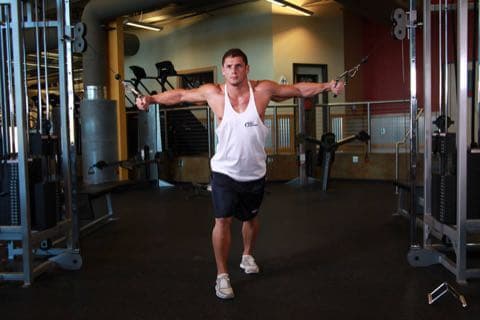
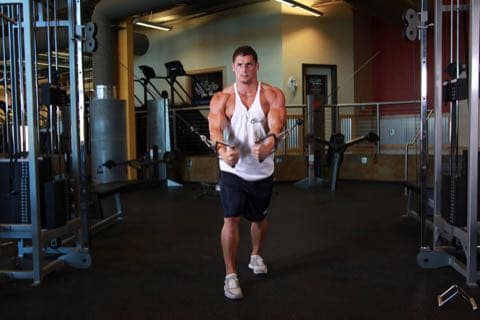
The cable crossover, also called the cable fly, is a chest exercise done between two cable towers. You hold a handle in each hand, arms out to the sides, and bring your hands together in front of you in a wide arc. The cables keep tension on the chest through the whole rep.
Updated November 2026
- Equipment
- Cable
- Primary
- Chest
- Secondary
- Shoulders
- Level
- Beginner
How to do it
- To get yourself into the starting position, place the pulleys on a high position (above your head), select the resistance to be used and hold the pulleys in each hand.
- Step forward in front of an imaginary straight line between both pulleys while pulling your arms together in front of you. Your torso should have a small forward bend from the waist. This will be your starting position.
- With a slight bend on your elbows in order to prevent stress at the biceps tendon, extend your arms to the side (straight out at both sides) in a wide arc until you feel a stretch on your chest. Breathe in as you perform this portion of the movement. Tip: Keep in mind that throughout the movement, the arms and torso should remain stationary; the movement should only occur at the shoulder joint.
- Return your arms back to the starting position as you breathe out. Make sure to use the same arc of motion used to lower the weights.
- Hold for a second at the starting position and repeat the movement for the prescribed amount of repetitions.
Instructions from free-exercise-db, public domain. It is the same text the app shows on this exercise.
Saying it out loud
Any of these logs a set of cable crossover in SayLift. Say the whole session in one go if you want, with weights, reps and sets in whatever order they come out.
You say
“”
Cable crossover
✓ Logged1You say it
2SayLift writes it
3You check and save
- “Cable crossover, three sets of twelve at 15”
- “Cable fly 20 for 12, 12 and 10”
- “Cable flyes 12.5 three by fifteen”
- “Cable chest fly 15 for 12”
Move at the shoulder, not the elbow
Keep a small, fixed bend in your elbows for the whole set. Your arms should move like wings. If your elbows bend and straighten each rep, the lift turns into a press and the chest works less.
Take one step forward from the towers and lean a little from the hips. Bring your hands together in front of your chest, squeeze for a moment, then let them open slowly until you feel a stretch.
- Soft elbows, the same bend from start to finish.
- Stagger your feet for balance.
- Squeeze at the middle for one second.
- Open slowly. Do not let the stack pull your arms back.
High, middle or low pulleys
Pulleys set high, as in the classic crossover, bring the hands down toward the hips and train the lower chest more. Pulleys at shoulder height give a flat fly. Pulleys set low bring the hands up and train the upper chest more.
Each height is a slightly different exercise. Pick one and keep it, or log the heights as separate exercises so your numbers stay comparable.
Logging cable weight
Cable numbers change from gym to gym because the pulleys differ. Log the number on the stack and treat your history as tied to that machine. Also note if you use one tower per hand or both hands on one stack.
With SayLift you can say "cable fly, 15 for 12, 12 and 10" and it is saved as a cable crossover.
Frequently asked questions
Is a cable crossover the same as a cable fly?
Mostly, yes. People use both names for the same movement. Some use "crossover" when the hands cross at the end of each rep.
How many reps for cable crossovers?
Most people use 10 to 15 reps with a weight they can control. Heavy sets tend to turn the fly into a press.
Cable fly or dumbbell fly?
Cables keep tension on the chest at the top of the rep, where a dumbbell fly gets easy. Dumbbells need no machine. Both work. Log them as separate exercises.
Stop typing between sets
Say what you lifted. SayLift writes down every set, rep and weight, then tells you what to lift next time. Say what you ate and it counts the calories too. iPhone and Android, 3 days free then $4.17 a month, billed $49.99 a year.


Reading this on a laptop? Scan to install.