Barbell bench press
The bench press is the most logged lift in any gym app and the one people most often run into a wall on, because the thing that stalls it is rarely the chest. Here is what it trains, the setup that decides how much you press before you touch the bar, and the way to keep a record of it that survives contact with a busy gym.
Updated September 2026
- Equipment
- Barbell
- Primary
- Chest
- Secondary
- Shoulders, Triceps
- Level
- Beginner
How to do it
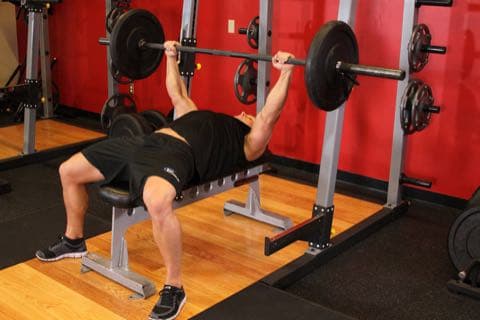
- Lie back on a flat bench. Using a medium width grip (a grip that creates a 90-degree angle in the middle of the movement between the forearms and the upper arms), lift the bar from the rack and hold it straight over you with your arms locked. This will be your starting position.
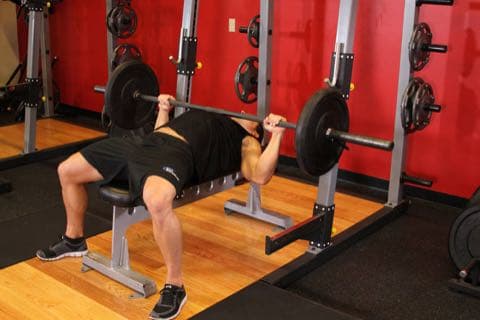
- From the starting position, breathe in and begin coming down slowly until the bar touches your middle chest.
- After a brief pause, push the bar back to the starting position as you breathe out. Focus on pushing the bar using your chest muscles. Lock your arms and squeeze your chest in the contracted position at the top of the motion, hold for a second and then start coming down slowly again. Tip: Ideally, lowering the weight should take about twice as long as raising it.
- Repeat the movement for the prescribed amount of repetitions.
- When you are done, place the bar back in the rack.
Instructions from free-exercise-db, public domain — the same text the app shows on this exercise.
Saying it out loud
Any of these logs a set of barbell bench press in SayLift. Say the whole session in one go if you want — weights, reps and sets in whatever order they come out.
- “Bench press, three sets of eight at 135”
- “Barbell bench, 135 for 8, 8 and 6”
- “Flat bench 185 five by five”
- “Bench press 225 for 3, then 205 for 5 and 5”
The setup does most of the work
Lifters who stall on bench usually have a setup problem rather than a chest problem. The bar path is decided before the bar moves: feet planted, shoulder blades pulled together and down into the bench, a small arch through the upper back. From there the shoulder sits in a stable position and the press has something to push against.
Flat on your back with loose shoulder blades, the joint takes the load directly and the press gets both weaker and more painful. This is why people report bench as their worst lift and their sore one at the same time — it is the same cause twice.
- Feet down, whole foot. Driving through the floor is not cheating, it is what keeps the arch.
- Squeeze the blades before the unrack, not after. Once the bar is out you cannot fix your position without losing tension.
- Touch point is the lower chest, not the neck. A bar coming down to the collarbone is a shoulder problem forming.
- Elbows around 45 degrees to the torso. Flared to 90 is the other way to hurt yourself.
SayLift logs your whole workout from one spoken sentence. iPhone only, 873 exercises built in, 3 days free then $49.99 a year.
Start the free trialWhat to log, and what to ignore
Weight and reps per working set, and nothing else, is enough to drive every progression decision. Warm-ups do not need to go in. Neither do the numbers people track because they feel thorough: the bar speed, the rest timer, the exact bench incline you never change.
What matters is that the record exists at all next week. The most common reason a bench progression stops is not a bad programme, it is three weeks of sets that never got written down, so nobody knows what the last working weight was.
This is the argument for saying it instead of typing it. Chalked hands and a phone keyboard between sets is the friction that ends most logging habits, and SayLift exists because of exactly that.
Frequently asked questions
How often should I bench press?
Twice a week suits most people better than once. The same weekly volume split across two sessions is easier to recover from set to set, and it gives you two chances a week to hit a rep target rather than one.
Why has my bench press stalled?
Usually one of three things: you are adding weight every session rather than chasing an extra rep first, you are not benching often enough to practise the movement, or your setup changes between sessions so no two presses are the same lift. Fix the record first — you cannot diagnose a stall you have no numbers for.
Is dumbbell bench press a good substitute?
For chest development, yes, and it is kinder to a cranky shoulder. It will not track the same numbers, so log it as its own exercise rather than continuing your barbell progression under a different name.
Stop typing between sets
Say what you lifted. SayLift writes down every set, rep and weight, then tells you what to lift next time. iPhone only, 3 days free then $49.99 a year.
Download on the App Store
Reading this on a laptop? Scan to install.