Barbell deadlift
The deadlift is the simplest lift to describe and the easiest to do badly under fatigue, because the failure mode is a rounded back rather than a missed rep. It is also the lift most worth logging accurately, since a deadlift progression that runs on memory tends to run on optimism. Here is the setup, what the movement trains, and what belongs in your log.
Updated September 2026
- Equipment
- Barbell
- Primary
- Lower back
- Secondary
- Calves, Forearms, Glutes, Hamstrings, Lats, Middle back, Quadriceps, Traps
- Level
- Intermediate
How to do it
- Stand in front of a loaded barbell.
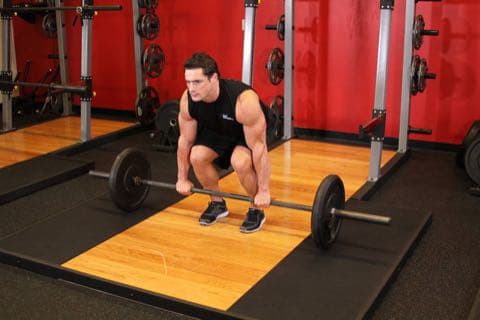
- While keeping the back as straight as possible, bend your knees, bend forward and grasp the bar using a medium (shoulder width) overhand grip. This will be the starting position of the exercise. Tip: If it is difficult to hold on to the bar with this grip, alternate your grip or use wrist straps.
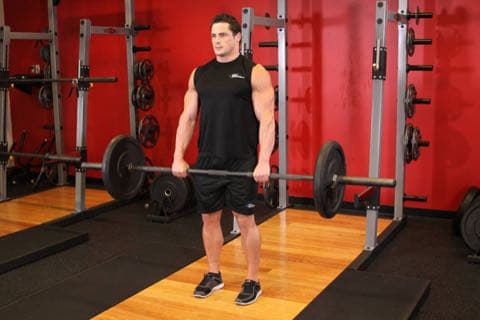
- While holding the bar, start the lift by pushing with your legs while simultaneously getting your torso to the upright position as you breathe out. In the upright position, stick your chest out and contract the back by bringing the shoulder blades back. Think of how the soldiers in the military look when they are in standing in attention.
- Go back to the starting position by bending at the knees while simultaneously leaning the torso forward at the waist while keeping the back straight. When the weights on the bar touch the floor you are back at the starting position and ready to perform another repetition.
- Perform the amount of repetitions prescribed in the program.
Instructions from free-exercise-db, public domain — the same text the app shows on this exercise.
Saying it out loud
Any of these logs a set of barbell deadlift in SayLift. Say the whole session in one go if you want — weights, reps and sets in whatever order they come out.
- “Deadlift, three sets of five at 315”
- “Deadlifts 405 for a single, then 315 for 5”
- “Conventional deadlift 225 five by three”
- “Deadlift 275 for 8, 8 and 6”
The setup that keeps your back out of it
Almost everything that goes wrong in a deadlift is decided in the two seconds before the bar leaves the floor. The bar should be over the middle of your foot, close enough to your shins to touch as it rises. Hips sit between a squat and a stiff-leg position, wherever puts your shoulders slightly ahead of the bar.
From there the cue that matters is taking the slack out: pull up against the bar until you feel the plates load before anything moves. Yanking a loose bar off the floor is how a flat back becomes a rounded one in the first inch.
- Bar over mid-foot, every rep. If it drifts forward, the pull gets heavier and your lower back takes the difference.
- Lats engaged, as if squeezing an orange in each armpit. This is what keeps the bar close.
- Finish standing, not leaning back. Hyperextending at the top adds nothing and compresses the spine.
- Reset each rep from the floor when going heavy. Bounced reps train something else.
SayLift logs your whole workout from one spoken sentence. iPhone only, 873 exercises built in, 3 days free then $49.99 a year.
Start the free trialLogging heavy, low-rep work
Deadlifts are usually programmed in fewer, heavier sets than everything else, which makes each set worth more in your log. A missed entry in a 3x5 bench session costs you a third of the information; a missed entry in a top single costs you the whole session.
Log the top set exactly, including whether you reset between reps and whether you used straps. Both change what the number means. A 405 strapped triple and a 405 double-overhand triple are not the same evidence for next week.
Straps in particular hide a grip limit rather than removing it, so a log that does not mark them will eventually show a pull you cannot actually hold.
Frequently asked questions
Should I use straps for deadlifts?
Use them for high-rep or accessory work when your grip fails before your back and legs do. Keep your heavy top sets double-overhand or hook grip for as long as you can, and note in your log which you used, because the numbers are not comparable.
How often should I deadlift?
Once a week suits most people. It is the lift with the highest recovery cost per set, and a second heavy day usually takes more than it gives unless you are training for it specifically.
Why does my lower back round at the bottom?
Usually the hips start too low, so the first inch becomes a leg press your back has to finish, or you are pulling before taking the slack out of the bar. Both show up at the same point in the lift, and both get worse as the set goes on.
Stop typing between sets
Say what you lifted. SayLift writes down every set, rep and weight, then tells you what to lift next time. iPhone only, 3 days free then $49.99 a year.
Download on the App Store
Reading this on a laptop? Scan to install.