Bent over barbell row
The barbell row builds more back than any other free-weight pull, and it is the lift where the weight in your log drifts furthest from the weight you actually rowed. Nobody decides to start using their hips; the torso just rises a few degrees a week. Here is what the movement trains and how to keep the record honest.
Updated September 2026
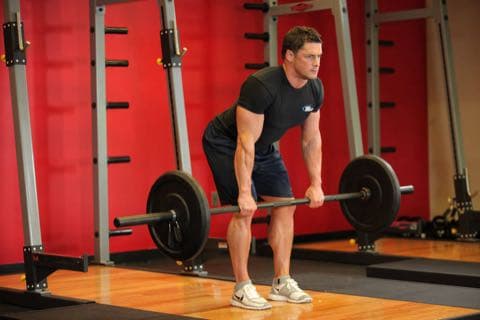
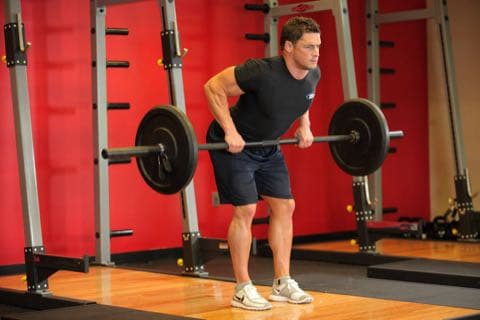
- Equipment
- Barbell
- Primary
- Middle back
- Secondary
- Biceps, Lats, Shoulders
- Level
- Beginner
How to do it
- Holding a barbell with a pronated grip (palms facing down), bend your knees slightly and bring your torso forward, by bending at the waist, while keeping the back straight until it is almost parallel to the floor. Tip: Make sure that you keep the head up. The barbell should hang directly in front of you as your arms hang perpendicular to the floor and your torso. This is your starting position.
- Now, while keeping the torso stationary, breathe out and lift the barbell to you. Keep the elbows close to the body and only use the forearms to hold the weight. At the top contracted position, squeeze the back muscles and hold for a brief pause.
- Then inhale and slowly lower the barbell back to the starting position.
- Repeat for the recommended amount of repetitions.
Instructions from free-exercise-db, public domain — the same text the app shows on this exercise.
Saying it out loud
Any of these logs a set of bent over barbell row in SayLift. Say the whole session in one go if you want — weights, reps and sets in whatever order they come out.
- “Barbell row, four sets of eight at 135”
- “Bent over row 155 for 10, 10 and 8”
- “Rows 185 three by six”
- “Barbell rows 95 for 12”
The torso angle is the exercise
A row at 45 degrees and a row at 80 degrees are different lifts with different leverages, and the second one is much easier. When a row goes up 40 lb in two months without the back changing, the torso angle is usually where the weight came from.
Pick an angle you can hold for every rep of every set — somewhere between horizontal and 45 degrees above it is standard — and let the weight be whatever that angle allows. If the last two reps of a set only happen by standing up, those reps were not rows.
Pull to the bottom of the sternum or upper abdomen, not the chest, and let the shoulder blades move. A row where the shoulders stay locked forward is an arm exercise.
SayLift logs your whole workout from one spoken sentence. iPhone only, 873 exercises built in, 3 days free then $49.99 a year.
Start the free trialLogging a lift that cheats gradually
Weight and reps, as usual, but rows benefit from one extra habit: note when you changed something. A strict row and a slightly bouncier row at the same weight look identical in a history and are not.
The simplest safeguard is keeping the rep range fixed and letting the weight move. If you row 8s and the weight is climbing, the progression is real. If the reps drift between 6 and 12 session to session, the numbers stop comparing.
Frequently asked questions
Barbell row or dumbbell row?
Barbell rows load more total weight and train the bracing; dumbbell rows give a longer range per side and let you fix a strength imbalance. Most programmes have room for both, logged separately.
Should I use an overhand or underhand grip?
Overhand hits the upper back and rear delts a little more, underhand brings the lats and biceps in and usually lets you row more. Both are legitimate, and switching mid-progression makes the weights incomparable.
Where should the bar touch?
Bottom of the sternum to the upper abdomen, depending on your torso angle. Pulling to the collarbone turns it into a high row, which trains the rear delts more and the lats less.
Stop typing between sets
Say what you lifted. SayLift writes down every set, rep and weight, then tells you what to lift next time. iPhone only, 3 days free then $49.99 a year.
Download on the App Store
Reading this on a laptop? Scan to install.