Dumbbell bench press
The dumbbell bench press is the flat press with a dumbbell in each hand. It trains the same chest, shoulders and triceps as the barbell bench, lets each arm find its own path, and needs no rack. The catch is that the two dumbbells add up to less than you bench on the bar, which surprises most people the first time they switch.
Updated September 2026
- Equipment
- Dumbbell
- Primary
- Chest
- Secondary
- Shoulders, Triceps
- Level
- Beginner
How to do it
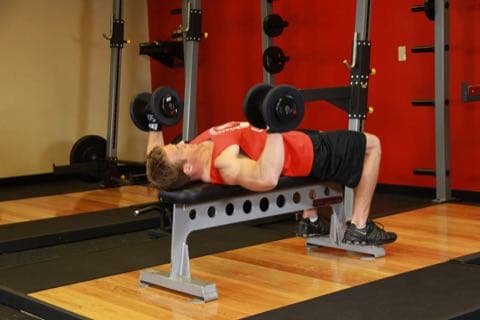
- Lie down on a flat bench with a dumbbell in each hand resting on top of your thighs. The palms of your hands will be facing each other.
- Then, using your thighs to help raise the dumbbells up, lift the dumbbells one at a time so that you can hold them in front of you at shoulder width.
- Once at shoulder width, rotate your wrists forward so that the palms of your hands are facing away from you. The dumbbells should be just to the sides of your chest, with your upper arm and forearm creating a 90 degree angle. Be sure to maintain full control of the dumbbells at all times. This will be your starting position.
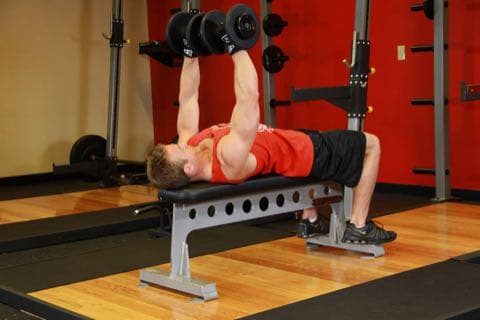
- Then, as you breathe out, use your chest to push the dumbbells up. Lock your arms at the top of the lift and squeeze your chest, hold for a second and then begin coming down slowly. Tip: Ideally, lowering the weight should take about twice as long as raising it.
- Repeat the movement for the prescribed amount of repetitions of your training program.
Instructions from free-exercise-db, public domain — the same text the app shows on this exercise.
Saying it out loud
Any of these logs a set of dumbbell bench press in SayLift. Say the whole session in one go if you want — weights, reps and sets in whatever order they come out.
- “Dumbbell bench press, three sets of ten at 60”
- “DB bench press 70 for 8, 8 and 6”
- “Dumbbell bench press 50, four by twelve”
Why two dumbbells add up to less than the bar
Each arm has to balance its own dumbbell as well as push it, and the dumbbells travel a little deeper at the bottom than a bar that stops on your chest. Both of those cost weight. Someone who benches 185 on the bar might press a pair of 70s, which is 140 in total.
There is nothing to fix there. It only means the two lifts need separate records. Carrying your barbell numbers across makes the dumbbell version look like a step backwards when it is a different lift.
SayLift logs your whole workout from one spoken sentence. iPhone only, 873 exercises built in, 3 days free then $49.99 a year.
Start the free trialForm that holds up under heavier dumbbells
Set up the same way you would for the barbell bench: feet planted, shoulder blades pulled back and down into the bench, a small arch through the upper back. The dumbbells do not change that part.
Press with your palms facing forward or turned slightly in. Many lifters find the slightly turned grip more comfortable, and it keeps the elbows from flaring straight out.
- Elbows about 45 degrees from your sides on the way down.
- Lower to the same depth each rep, with the dumbbells about level with your chest.
- Press up and slightly in. Finish with the dumbbells above your shoulders, a few inches apart.
Logging it as its own lift
Log the weight of one dumbbell, the number printed on it. "70 for 8" means a pair of 70s, and that is how gyms and programmes read it too.
Give it its own place in your log. In SayLift, the progress dashboard shows personal records and each lift against its last session, and warm-up sets never count toward records. That only tells you something useful when the dumbbell press and the barbell press are logged as two exercises.
Frequently asked questions
Is the dumbbell bench press better than the barbell bench press?
They do the same job with different trade-offs. Dumbbells give a longer range and make each side work alone. The barbell lets you load more and add weight in small steps. Plenty of programmes use both.
How heavy should my dumbbells be compared with my barbell bench?
Expect each dumbbell to be well under half of your barbell weight at first. The gap usually closes a little with practice. Set your weights from your own dumbbell history rather than a ratio.
Do I log one dumbbell or both?
One. The number on the dumbbell is what gyms, programmes and most apps mean, so a log that says 60 means a pair of 60s.
Stop typing between sets
Say what you lifted. SayLift writes down every set, rep and weight, then tells you what to lift next time. iPhone only, 3 days free then $49.99 a year.
Download on the App Store
Reading this on a laptop? Scan to install.