Leg press
The leg press is where the biggest numbers in any gym get written down, and almost none of them mean what they look like. It is a genuinely useful quad builder with a low skill cost and a low recovery cost. It is also the lift most likely to make a training log look better than the training was.
Updated September 2026
- Equipment
- Machine
- Primary
- Quadriceps
- Secondary
- Calves, Glutes, Hamstrings
- Level
- Beginner
How to do it
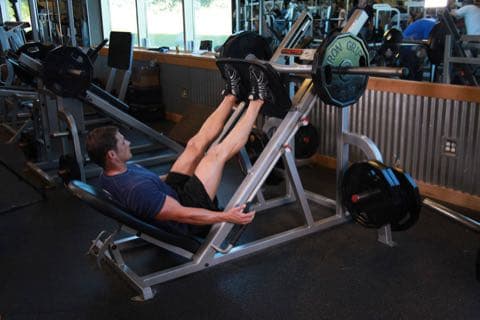
- Using a leg press machine, sit down on the machine and place your legs on the platform directly in front of you at a medium (shoulder width) foot stance. (Note: For the purposes of this discussion we will use the medium stance described above which targets overall development; however you can choose any of the three stances described in the foot positioning section).
- Lower the safety bars holding the weighted platform in place and press the platform all the way up until your legs are fully extended in front of you. Tip: Make sure that you do not lock your knees. Your torso and the legs should make a perfect 90-degree angle. This will be your starting position.
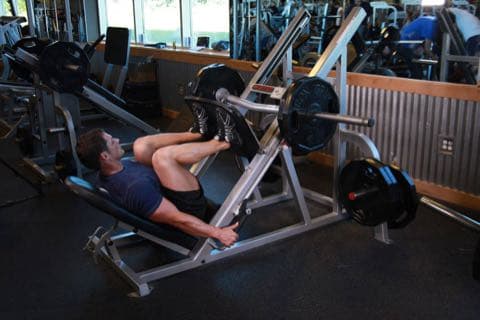
- As you inhale, slowly lower the platform until your upper and lower legs make a 90-degree angle.
- Pushing mainly with the heels of your feet and using the quadriceps go back to the starting position as you exhale.
- Repeat for the recommended amount of repetitions and ensure to lock the safety pins properly once you are done. You do not want that platform falling on you fully loaded.
Instructions from free-exercise-db, public domain — the same text the app shows on this exercise.
Saying it out loud
Any of these logs a set of leg press in SayLift. Say the whole session in one go if you want — weights, reps and sets in whatever order they come out.
- “Leg press, three sets of twelve at 270”
- “Leg press 360 for 10, 10 and 8”
- “Leg presses 180 four by fifteen”
- “Leg press 450 for 8”
The number on the sled is not the weight
A 45-degree leg press moves the load along a ramp, so the resistance you feel is a fraction of the plates on it, and the sled itself weighs something the plates do not show. Different machines differ enough that the same plate count can be a very different effort.
None of that makes the exercise less useful. It does mean a leg press number is a record of your own progress on one machine, not a strength statistic, and comparing it with a squat or with someone else's sled is meaningless.
SayLift logs your whole workout from one spoken sentence. iPhone only, 873 exercises built in, 3 days free then $49.99 a year.
Start the free trialDepth and foot placement
Go as deep as you can without your lower back peeling off the pad. The moment the pelvis tucks under, the spine takes the load and the exercise stops being safe. That point is usually higher than people think and it is not negotiable by adding a plate.
Feet higher on the platform shifts work toward the glutes and hamstrings; lower puts it on the quads. Narrow and wide stances shift it slightly again. Pick one and keep it, because changing foot position changes the exercise more than changing the weight does.
- Do not lock the knees out hard at the top. Stop just short.
- Never put your hands on your knees to push out of the bottom — that is how people get hurt on this machine.
- Same machine, same seat setting, if your gym has more than one.
Frequently asked questions
Is the leg press as good as squats?
For quad size, it is close and it costs much less recovery. For everything a squat also trains — bracing, balance, the whole posterior chain working together — it is not a replacement. Most people benefit from having both.
Why can I leg press so much more than I squat?
Because the sled travels on a ramp, the machine supports your torso, and the range is shorter. The ratio is normal and tells you nothing about your squat.
How deep should I go on the leg press?
Until just before your lower back lifts off the pad. Rounding at the bottom under a loaded sled is the main injury risk on this machine.
Stop typing between sets
Say what you lifted. SayLift writes down every set, rep and weight, then tells you what to lift next time. iPhone only, 3 days free then $49.99 a year.
Download on the App Store
Reading this on a laptop? Scan to install.