Romanian deadlift
The Romanian deadlift is the hinge people think they are doing when they do a stiff-leg deadlift, and the two get logged interchangeably far more often than they should be. It is a hamstring and glute movement with a deliberately short range, and the thing that makes it work is where you stop, not how low you get.
Updated September 2026
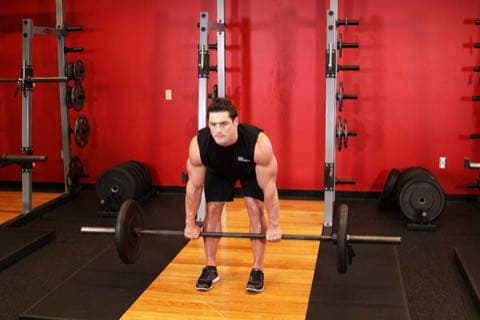
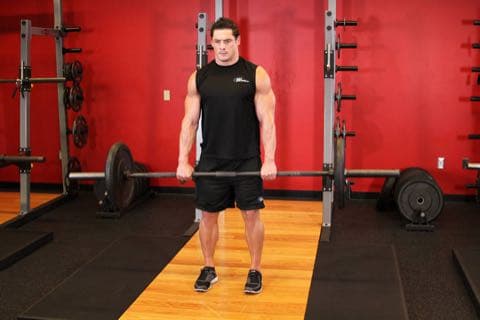
- Equipment
- Barbell
- Primary
- Hamstrings
- Secondary
- Calves, Glutes, Lower back
- Level
- Intermediate
How to do it
- Put a barbell in front of you on the ground and grab it using a pronated (palms facing down) grip that a little wider than shoulder width. Tip: Depending on the weight used, you may need wrist wraps to perform the exercise and also a raised platform in order to allow for better range of motion.
- Bend the knees slightly and keep the shins vertical, hips back and back straight. This will be your starting position.
- Keeping your back and arms completely straight at all times, use your hips to lift the bar as you exhale. Tip: The movement should not be fast but steady and under control.
- Once you are standing completely straight up, lower the bar by pushing the hips back, only slightly bending the knees, unlike when squatting. Tip: Take a deep breath at the start of the movement and keep your chest up. Hold your breath as you lower and exhale as you complete the movement.
- Repeat for the recommended amount of repetitions.
Instructions from free-exercise-db, public domain — the same text the app shows on this exercise.
Saying it out loud
Any of these logs a set of romanian deadlift in SayLift. Say the whole session in one go if you want — weights, reps and sets in whatever order they come out.
- “RDL, three sets of ten at 135”
- “Romanian deadlift 185 for 10, 10 and 8”
- “Romanian deadlifts three by twelve at 95”
- “RDLs 225 for 8”
It ends where the stretch ends
The rep finishes when your hamstrings stop lengthening, not when the plates touch the floor. For most people that is somewhere between mid-shin and just below the knee, with the back flat the whole way. Going lower does not add hamstring work; it adds lower back rounding, which is a different exercise and a worse one.
The knees stay softly bent and unchanged throughout. If they bend further as you descend, you have turned the lift into a deadlift with a long setup.
The hips travel backwards, not down. A useful check: standing a foot from a wall and touching it with your backside is roughly the movement you want.
SayLift logs your whole workout from one spoken sentence. iPhone only, 873 exercises built in, 3 days free then $49.99 a year.
Start the free trialWhy it needs logging more than the big lifts
RDLs are an accessory for most people, which means they get half a notebook line and no attention, which means they sit at the same weight for months. Accessories are where progression quietly stops, because nobody tracks the lifts they do not care about.
Weight and reps are enough, but log them every session. A hamstring exercise that has not moved since spring is the reason a deadlift will not move either.
Frequently asked questions
What is the difference between a Romanian deadlift and a stiff-leg deadlift?
An RDL starts from the top, keeps a soft unchanging knee bend, and stops when the hamstring stretch runs out. A stiff-leg deadlift starts from the floor with straighter legs and a longer range. They train similar things, but they are different lifts and should be separate entries in your log.
How low should I go on an RDL?
Until your hamstrings are fully stretched and your back is still flat — usually mid-shin to just below the knee. The floor is not the target.
Should I feel RDLs in my lower back?
A little bracing effort is normal, but the working sensation should be the hamstrings. If your lower back is doing the work, you are going too low, rounding, or letting the bar drift away from your legs.
Stop typing between sets
Say what you lifted. SayLift writes down every set, rep and weight, then tells you what to lift next time. iPhone only, 3 days free then $49.99 a year.
Download on the App Store
Reading this on a laptop? Scan to install.