Triceps pushdown
The pushdown is the most common triceps exercise in any gym and the one most often turned into a partial chest press. It is a good, low-risk way to add triceps volume after pressing — provided the elbows stay where they started and the weight stays honest.
Updated September 2026
- Equipment
- Cable
- Primary
- Triceps
- Secondary
- —
- Level
- Beginner
How to do it
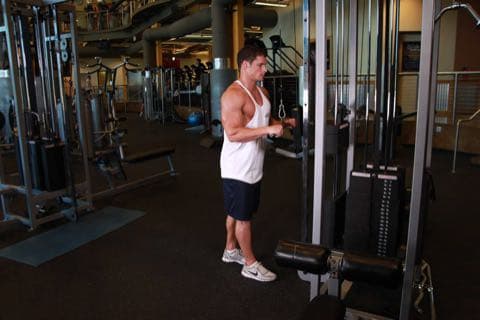
- Attach a straight or angled bar to a high pulley and grab with an overhand grip (palms facing down) at shoulder width.
- Standing upright with the torso straight and a very small inclination forward, bring the upper arms close to your body and perpendicular to the floor. The forearms should be pointing up towards the pulley as they hold the bar. This is your starting position.
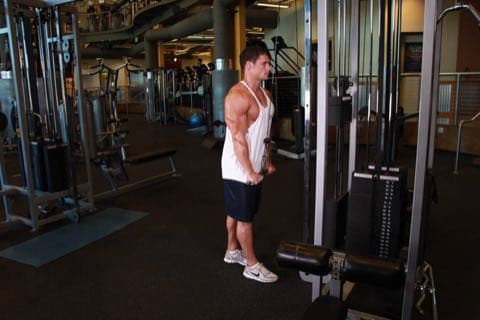
- Using the triceps, bring the bar down until it touches the front of your thighs and the arms are fully extended perpendicular to the floor. The upper arms should always remain stationary next to your torso and only the forearms should move. Exhale as you perform this movement.
- After a second hold at the contracted position, bring the bar slowly up to the starting point. Breathe in as you perform this step.
- Repeat for the recommended amount of repetitions.
Instructions from free-exercise-db, public domain — the same text the app shows on this exercise.
Saying it out loud
Any of these logs a set of triceps pushdown in SayLift. Say the whole session in one go if you want — weights, reps and sets in whatever order they come out.
- “Triceps pushdowns, three sets of twelve at 50”
- “Pushdowns 70 for 12, 10 and 10”
- “Rope pushdown 40 three by fifteen”
- “Tricep pushdown 60 for 12”
Keep the elbows out of it
The elbows are a hinge, not a lever. They stay pinned at your sides and the only thing that moves is the forearm. The moment the elbows drift forward or your torso starts leaning into the bar, you have turned a triceps isolation into a bad chest press and the weight stops meaning anything.
Stand close enough to the stack that the cable is roughly vertical at the top of the rep. Lock out fully at the bottom and let the weight stretch the triceps at the top without the stack touching down.
- Rope lets you spread at the bottom and gives the longest range.
- Straight or V-bar lets you load more weight with a fixed hand position.
- Reverse grip biases the long head slightly; it also needs a much lighter weight.
SayLift logs your whole workout from one spoken sentence. iPhone only, 873 exercises built in, 3 days free then $49.99 a year.
Start the free trialLogging cable work
As with any stack, the number is gym-specific — cable machines vary in both plate weight and pulley ratio, so 50 on one machine can be noticeably heavier than 50 on another. Record the stack number and treat the exercise as tied to that gym.
Also record the attachment. Rope, straight bar and V-bar pushdowns take different weights, and a history that mixes all three without saying which reads as random noise.
Frequently asked questions
Rope or bar for pushdowns?
Rope gives a longer range and lets the hands separate at the bottom, which most people find hits the triceps harder. A bar lets you load more weight. Both work; log them as separate exercises.
Why do pushdowns hurt my elbows?
Usually locking out hard with a heavy weight and a straight bar, which puts the wrists and elbows in a fixed position they cannot adjust out of. Try the rope, go lighter, and stop just short of a forced lockout.
Are pushdowns enough for triceps?
They train the triceps well but favour the lateral and medial heads. Add an overhead extension of some kind if you want the long head, which only stretches fully with the arm overhead.
Stop typing between sets
Say what you lifted. SayLift writes down every set, rep and weight, then tells you what to lift next time. iPhone only, 3 days free then $49.99 a year.
Download on the App Store
Reading this on a laptop? Scan to install.