Lat pulldown
The lat pulldown is the most used machine in most gyms and the most misreported lift in most logs, because "plate 9" on one stack is not "plate 9" on another. It is a genuinely good back builder and the main path to a first pull-up. Here is how to do it and how to record it so the numbers survive a change of gym.
Updated September 2026
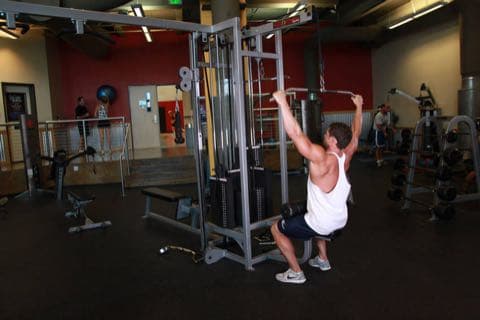
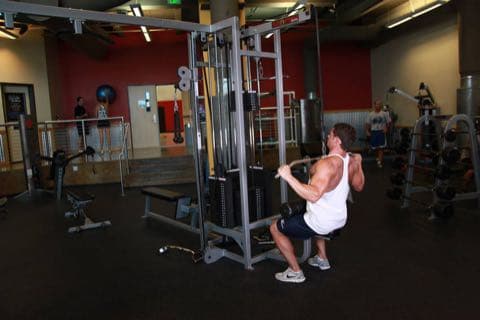
- Equipment
- Cable
- Primary
- Lats
- Secondary
- Biceps, Middle back, Shoulders
- Level
- Beginner
How to do it
- Sit down on a pull-down machine with a wide bar attached to the top pulley. Make sure that you adjust the knee pad of the machine to fit your height. These pads will prevent your body from being raised by the resistance attached to the bar.
- Grab the bar with the palms facing forward using the prescribed grip. Note on grips: For a wide grip, your hands need to be spaced out at a distance wider than shoulder width. For a medium grip, your hands need to be spaced out at a distance equal to your shoulder width and for a close grip at a distance smaller than your shoulder width.
- As you have both arms extended in front of you holding the bar at the chosen grip width, bring your torso back around 30 degrees or so while creating a curvature on your lower back and sticking your chest out. This is your starting position.
- As you breathe out, bring the bar down until it touches your upper chest by drawing the shoulders and the upper arms down and back. Tip: Concentrate on squeezing the back muscles once you reach the full contracted position. The upper torso should remain stationary and only the arms should move. The forearms should do no other work except for holding the bar; therefore do not try to pull down the bar using the forearms.
- After a second at the contracted position squeezing your shoulder blades together, slowly raise the bar back to the starting position when your arms are fully extended and the lats are fully stretched. Inhale during this portion of the movement.
- Repeat this motion for the prescribed amount of repetitions.
Instructions from free-exercise-db, public domain — the same text the app shows on this exercise.
Saying it out loud
Any of these logs a set of lat pulldown in SayLift. Say the whole session in one go if you want — weights, reps and sets in whatever order they come out.
- “Lat pulldown, three sets of twelve at 120”
- “Pulldowns 140 for 10, 10 and 8”
- “Wide grip pulldown 100 three by twelve”
- “Lat pulldown 160 for 8”
Pull with your back, not your arms
The rep starts with the shoulder blades, not the elbows. Before the bar moves, pull the blades down and back; then drive the elbows toward your ribs. If you start by bending the arms, the biceps take the set and the lats get whatever is left.
Lean back slightly and hold that lean. Rocking backwards as the set gets hard adds weight you did not lift. Bring the bar to the collarbone, pause briefly, and control the way up — the stretch at the top is part of the exercise, not a reset.
- Grip just outside shoulder width is enough. Extreme wide grips shorten the range without adding lat work.
- Do not pull behind the neck. It puts the shoulder in its least stable position for no extra benefit.
- Let the arms straighten fully at the top, with the blades still under control.
SayLift logs your whole workout from one spoken sentence. iPhone only, 873 exercises built in, 3 days free then $49.99 a year.
Start the free trialLogging stack weights that do not travel
Machine stacks are not standardised. The same pin position can be 10 lb apart between two brands, and some stacks are marked in plates rather than weight at all. A pulldown history is therefore only comparable within one gym, on one machine.
The practical answer is to record the number on the stack and treat the exercise as gym-specific. When you move gyms, recalibrate over a session or two rather than trying to match the old number — the coach in SayLift treats a movement you have not logged in a while as a calibration set for the same reason.
Frequently asked questions
Are lat pulldowns as good as pull-ups?
For lat development at a matched effort, close. Pull-ups add the bracing and the bodyweight element and are harder to scale down; pulldowns are easier to load precisely, which makes them better for progression while you build up to pull-ups.
Should I pull the bar behind my neck?
No. It forces the shoulder into external rotation at the end of its range, and it does not train the lats any better than pulling to the collarbone.
How wide should my grip be?
Slightly wider than shoulder width. Very wide grips cut the range of motion short, and the extra lat activation people claim for them does not hold up.
Stop typing between sets
Say what you lifted. SayLift writes down every set, rep and weight, then tells you what to lift next time. iPhone only, 3 days free then $49.99 a year.
Download on the App Store
Reading this on a laptop? Scan to install.