Dips
Dips are a bodyweight pushing exercise done on two parallel bars. You hold yourself up with straight arms, lower your body by bending your elbows, and push back up. Dips train the triceps, the chest and the front of the shoulders.
Updated November 2026
- Equipment
- Other
- Primary
- Triceps
- Secondary
- Chest, Shoulders
- Level
- Beginner
How to do it
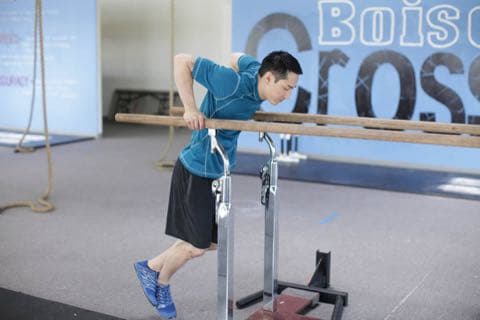
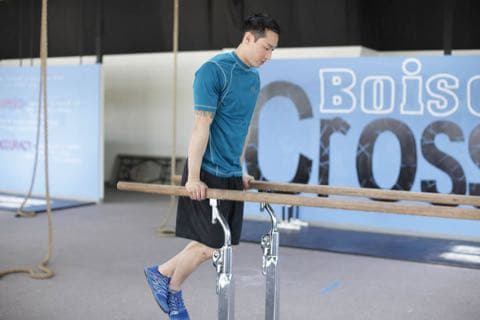
- Stand between a set of parallel bars. Place a hand on each bar, and then take a small jump to help you get into the starting position with your arms locked out.
- Begin by flexing the elbow, lowering your body until your arms break 90 degrees. Avoid swinging, and maintain good posture throughout the descent.
- Reverse the motion by extending the elbow, pushing yourself back up into the starting position.
- Repeat for the desired number of repetitions.
Instructions from free-exercise-db, public domain. It is the same text the app shows on this exercise.
Saying it out loud
Any of these logs a set of dips in SayLift. Say the whole session in one go if you want, with weights, reps and sets in whatever order they come out.
You say
“”
Dips
✓ Logged1You say it
2SayLift writes it
3You check and save
- “Dips, three sets of ten”
- “Dips bodyweight 10, 8 and 7”
- “Weighted dips 20 kilos for 6, 6 and 5”
- “Parallel bar dips three sets to failure”
How deep to go
Lower yourself until your upper arms are about level with the floor, or a little below if your shoulders feel fine. Going much deeper puts strain on the front of the shoulder for little extra gain.
Keep the depth the same on every rep. If some reps are deep and some are shallow, your rep count stops meaning much.
- Start with straight arms, shoulders down, away from your ears.
- Lower slowly until your upper arms are about level.
- Lean forward a little for more chest, stay upright for more triceps.
- No bouncing at the bottom.
Building up to full dips
If you cannot do five clean dips yet, start with negatives. Jump to the top and lower yourself slowly. An assisted dip machine or a band works too. Use less help as you get stronger.
Bench dips, with your hands on a bench behind you, are easier but train the movement differently. Treat them as a separate exercise.
Logging dips
Log reps for every set. When you can do about twelve good reps, add weight with a dip belt and log that weight. On an assisted machine, log the assistance number and note that it is assistance, because a lower number means a harder set.
With SayLift you can say "dips, bodyweight, 10, 8 and 7" between sets.
Frequently asked questions
Do dips work the chest or the triceps?
Both. The triceps do most of the work. Leaning your body forward brings in more chest, and staying upright keeps more of the work on the triceps.
Are dips bad for your shoulders?
For most people, dips at a sensible depth are fine. Going very deep or bouncing at the bottom can irritate the shoulder. If dips hurt, reduce the depth or skip them and talk to a professional.
How many dips should I do?
Three sets close to your limit is a good start. Most people use 6 to 12 reps. Add weight once you can do more than about twelve clean reps.
Stop typing between sets
Say what you lifted. SayLift writes down every set, rep and weight, then tells you what to lift next time. Say what you ate and it counts the calories too. iPhone and Android, 3 days free then $4.17 a month, billed $49.99 a year.


Reading this on a laptop? Scan to install.