Dumbbell lateral raise
The lateral raise is the only real way to load the side delt, and it is the exercise most often ruined by ego. It works in a weight range that feels embarrassing and progresses in increments most dumbbell racks do not have. That combination is why so many logs show the same 20s for two years.
Updated September 2026
- Equipment
- Dumbbell
- Primary
- Shoulders
- Secondary
- —
- Level
- Beginner
How to do it
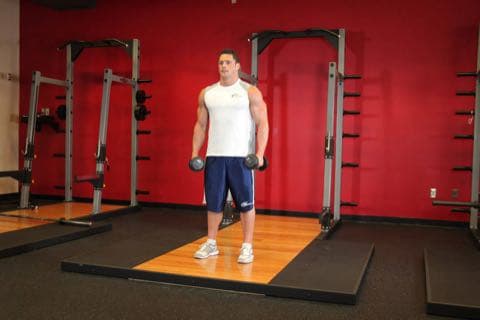
- Pick a couple of dumbbells and stand with a straight torso and the dumbbells by your side at arms length with the palms of the hand facing you. This will be your starting position.
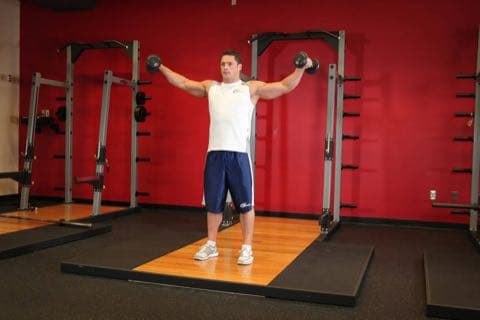
- While maintaining the torso in a stationary position (no swinging), lift the dumbbells to your side with a slight bend on the elbow and the hands slightly tilted forward as if pouring water in a glass. Continue to go up until you arms are parallel to the floor. Exhale as you execute this movement and pause for a second at the top.
- Lower the dumbbells back down slowly to the starting position as you inhale.
- Repeat for the recommended amount of repetitions.
Instructions from free-exercise-db, public domain — the same text the app shows on this exercise.
Saying it out loud
Any of these logs a set of dumbbell lateral raise in SayLift. Say the whole session in one go if you want — weights, reps and sets in whatever order they come out.
- “Lateral raises, three sets of fifteen at 15”
- “Side lateral raise 20s for 12, 10 and 10”
- “Lateral raises 12 pounds three by twenty”
- “Dumbbell lateral raise 25 for 8”
Lighter than you want it to be
If the dumbbells swing up, your traps shrug, or your torso rocks to start the rep, the side delt is not doing the work. The weight that makes this exercise work is usually half what people reach for.
Raise to roughly shoulder height, no higher — above that the traps take over. Lead with the elbows rather than the hands, keep a slight bend in the arm, and lower under control rather than letting gravity do it. The lowering half is where a lot of the growth is.
A small forward lean lets you keep tension through more of the range than standing bolt upright does.
SayLift logs your whole workout from one spoken sentence. iPhone only, 873 exercises built in, 3 days free then $49.99 a year.
Start the free trialProgressing an exercise with no small plates
Dumbbells usually jump in 5 lb steps, which on a 15 lb lateral raise is a 33 percent increase. Trying to progress by weight alone means never progressing at all.
So progress by reps first, over a wide range: take 15s from 12 reps to 20 over several weeks, then move to 20s and start again at 12. Logging each set's reps rather than just the weight is what makes that visible — a weight-only history of this exercise looks flat even when it is not.
Cable lateral raises solve the increment problem entirely if your gym has a low pulley, and they keep tension at the bottom where dumbbells have none.
Frequently asked questions
How heavy should lateral raises be?
Light enough that you can raise the dumbbells without swinging and lower them under control. For most people that is 10 to 25 lb, and going heavier just hands the work to the traps.
Should I raise above shoulder height?
No. Past shoulder height the trapezius takes over, and the side delt has already done its job.
Why do I feel lateral raises in my traps?
Usually the weight is too heavy, or you are shrugging to start the rep. Go lighter, keep the shoulders down, and lead with the elbow.
Stop typing between sets
Say what you lifted. SayLift writes down every set, rep and weight, then tells you what to lift next time. iPhone only, 3 days free then $49.99 a year.
Download on the App Store
Reading this on a laptop? Scan to install.