Overhead press
The standing overhead press is the lift that humbles people who bench well. It moves in the smallest increments of any barbell movement, which makes it the one where accurate records matter most: five pounds is a big jump on a press, and guessing at last week's weight will cost you the session.
Updated September 2026
- Equipment
- Barbell
- Primary
- Shoulders
- Secondary
- Triceps
- Level
- Beginner
How to do it
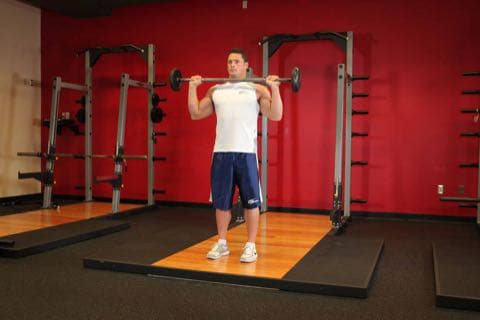
- Start by placing a barbell that is about chest high on a squat rack. Once you have selected the weights, grab the barbell using a pronated (palms facing forward) grip. Make sure to grip the bar wider than shoulder width apart from each other.
- Slightly bend the knees and place the barbell on your collar bone. Lift the barbell up keeping it lying on your chest. Take a step back and position your feet shoulder width apart from each other.
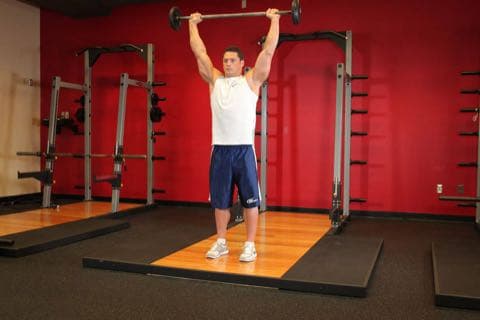
- Once you pick up the barbell with the correct grip length, lift the bar up over your head by locking your arms. Hold at about shoulder level and slightly in front of your head. This is your starting position.
- Lower the bar down to the collarbone slowly as you inhale.
- Lift the bar back up to the starting position as you exhale.
- Repeat for the recommended amount of repetitions.
Instructions from free-exercise-db, public domain — the same text the app shows on this exercise.
Saying it out loud
Any of these logs a set of overhead press in SayLift. Say the whole session in one go if you want — weights, reps and sets in whatever order they come out.
- “Overhead press, three sets of five at 95”
- “OHP 115 for 5, 4 and 4”
- “Military press 85 three by eight”
- “Standing press 135 for a double”
Getting the bar past your face
The press fails at the start more than at the top. The bar has to travel around your head, and the way to make that cheap is to move your head rather than the bar: pull the chin back as the bar leaves the shoulders, then push the head back through as the bar clears.
The other half is the finish. A press that ends with the bar in front of your forehead is not locked out. It should end over the middle of your foot, with your ribs down and your glutes tight so your lower back is not doing the work of the shoulders.
- Elbows slightly in front of the bar at the start, not directly underneath.
- Squeeze your glutes. Without that, the press becomes a standing incline bench with your spine as the bench.
- Bar over mid-foot at lockout, head through.
SayLift logs your whole workout from one spoken sentence. iPhone only, 873 exercises built in, 3 days free then $49.99 a year.
Start the free trialWhy it stalls first, and what to do
The overhead press uses the least muscle mass of the four barbell lifts, so it adds weight the slowest. Adding 5 lb a week to a bench is ambitious; adding it to a press is fantasy after the first month. Progress here usually looks like an extra rep, then another, then a small jump.
This is exactly the case for logging reps rather than just weight. A log that says "95 x 5, 5, 4" then "95 x 5, 5, 5" shows progress that a weight-only record would call a stall. Over a year of pressing, that distinction is most of the progress.
It is also why the hold decision matters more here than anywhere: keeping the weight and chasing one more rep is the right answer far more often than adding a plate.
Frequently asked questions
Why is my overhead press so much weaker than my bench?
Because it should be. A standing press typically sits around 60 to 65 percent of a bench press, since it uses less muscle and gives you no bench to push against. A press that is close to your bench usually means the bench has room to grow.
Should I press seated or standing?
Standing if you want the whole movement, including the bracing. Seated removes the trunk work and usually lets you press slightly more. Both are fine, and they are separate entries in your log.
Is push press a substitute?
No — the leg drive changes the exercise. Use it to overload the top of the movement if you want, but log it separately or your press numbers will stop meaning anything.
Stop typing between sets
Say what you lifted. SayLift writes down every set, rep and weight, then tells you what to lift next time. iPhone only, 3 days free then $49.99 a year.
Download on the App Store
Reading this on a laptop? Scan to install.