Dumbbell lunge
The dumbbell lunge trains the quads and glutes one leg at a time. You hold a dumbbell in each hand, step forward, and lower your back knee toward the floor. Because each leg works on its own, it also tests balance and shows if one side is weaker.
Updated November 2026
- Equipment
- Dumbbell
- Primary
- Quadriceps
- Secondary
- Calves, Glutes, Hamstrings
- Level
- Beginner
How to do it
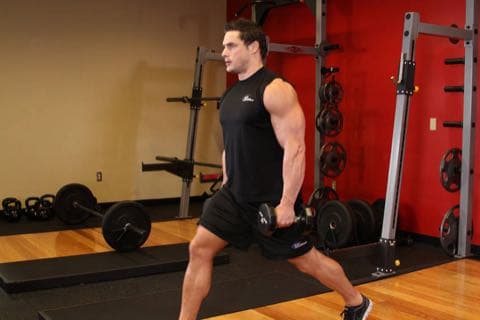
- Stand with your torso upright holding two dumbbells in your hands by your sides. This will be your starting position.
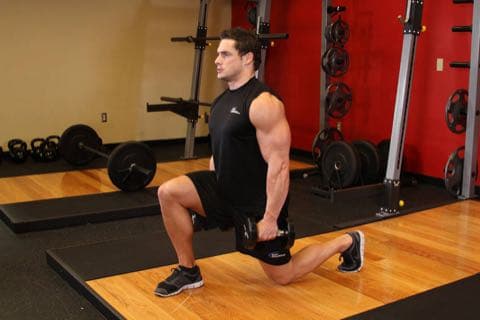
- Step forward with your right leg around 2 feet or so from the foot being left stationary behind and lower your upper body down, while keeping the torso upright and maintaining balance. Inhale as you go down. Note: As in the other exercises, do not allow your knee to go forward beyond your toes as you come down, as this will put undue stress on the knee joint. Make sure that you keep your front shin perpendicular to the ground.
- Using mainly the heel of your foot, push up and go back to the starting position as you exhale.
- Repeat the movement for the recommended amount of repetitions and then perform with the left leg.
Instructions from free-exercise-db, public domain. It is the same text the app shows on this exercise.
Saying it out loud
Any of these logs a set of dumbbell lunge in SayLift. Say the whole session in one go if you want, with weights, reps and sets in whatever order they come out.
You say
“”
Dumbbell lunge
✓ Logged1You say it
2SayLift writes it
3You check and save
- “Dumbbell lunges, three sets of ten at 15”
- “Dumbbell lunge 20 for 10, 10 and 8”
- “DB lunges 12 three by twelve”
- “Dumbbell lunges 15 for 10”
Step, drop, push back
Stand tall with a dumbbell in each hand at your sides. Take a step forward. Lower your body until your back knee is just above the floor and your front shin is close to vertical. Push through your front foot to stand back up.
Keep your chest up and your front knee in line with your toes. Your weight should stay on the front foot, not the back one.
- Longer step puts more work on the glutes.
- Shorter step puts more work on the quads.
- Feet hip width apart, not on one line, helps your balance.
- Touch nothing with the back knee. Stop just above the floor.
Balance comes first
Most people lose balance before the legs get tired. Start lighter than you think. If you wobble, use a slightly wider stance, or do the lunges in place instead of walking.
Walking lunges and lunges in place are both fine. They feel different, so log them as two exercises.
Logging a lunge
Log the weight of one dumbbell. Decide once whether a rep is one step or one step on each leg, and keep that rule. A history that mixes the two shows a jump or a drop that never happened.
Lunges are often the last exercise of leg day, so the numbers move slowly. A log shows the small changes. With SayLift you can say "dumbbell lunges, 15 for 10, 10 and 8" while you catch your breath.
Frequently asked questions
Do lunges count each leg as one rep?
There is no single rule. Some people count one step as one rep, others count both legs as one rep. Pick one way and use it every time so your log makes sense.
Why do my knees hurt during lunges?
Often because the front knee moves far past the toes or caves inward. Take a longer step, keep the knee over the toes, and go lighter. If pain continues, talk to a professional.
Lunges or squats?
Squats let you lift more weight with both legs. Lunges train one leg at a time and test balance. Many leg days include both.
Stop typing between sets
Say what you lifted. SayLift writes down every set, rep and weight, then tells you what to lift next time. Say what you ate and it counts the calories too. iPhone and Android, 3 days free then $4.17 a month, billed $49.99 a year.


Reading this on a laptop? Scan to install.