Goblet squat
The goblet squat is a squat holding one dumbbell or kettlebell against your chest. The weight in front works as a counterbalance, so most people can sit deeper and stay more upright than they can with a bar on their back. That makes it the usual first squat in a beginner programme, and a good leg exercise in its own right.
Updated September 2026
- Equipment
- Kettlebells
- Primary
- Quadriceps
- Secondary
- Calves, Glutes, Hamstrings, Shoulders
- Level
- Beginner
How to do it
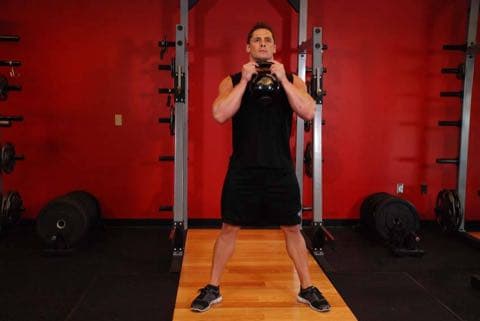
- Stand holding a light kettlebell by the horns close to your chest. This will be your starting position.
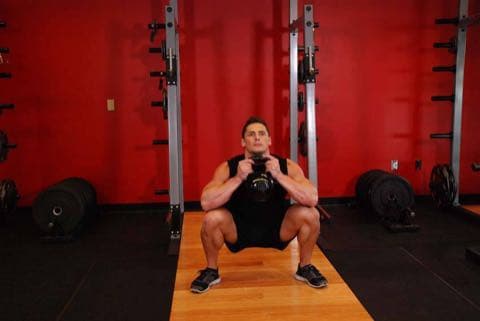
- Squat down between your legs until your hamstrings are on your calves. Keep your chest and head up and your back straight.
- At the bottom position, pause and use your elbows to push your knees out. Return to the starting position, and repeat for 10-20 repetitions.
Instructions from free-exercise-db, public domain — the same text the app shows on this exercise.
Saying it out loud
Any of these logs a set of goblet squat in SayLift. Say the whole session in one go if you want — weights, reps and sets in whatever order they come out.
- “Goblet squats, three sets of twelve at 50”
- “Goblet squat 60 for 10, 10 and 8”
- “Kettlebell goblet squat 24 kilos, four by ten”
Hold it high and close
Hold a kettlebell by the horns, or a dumbbell upright by one end with both hands cupped under the top plate. Keep it touching your chest for the whole set. If it drifts away from you, your upper back rounds forward to chase it.
Stand with your feet about shoulder width apart and your toes turned out a little. Sit straight down between your heels and let your knees travel forward over your toes. At the bottom, your elbows can sit just inside your knees and nudge them out.
- Chest up, eyes forward. The weight in front helps you stay upright, so use it.
- Whole foot on the floor. If your heels lift, widen your stance or turn your toes out a bit more.
- Same depth every rep. Hip crease below the knee is the usual target, as long as your back stays flat.
SayLift logs your whole workout from one spoken sentence. iPhone only, 873 exercises built in, 3 days free then $49.99 a year.
Start the free trialWhen it stops being enough
Sooner or later, holding the weight becomes the hard part. When you are using the heaviest dumbbell you can get to your chest and your legs still finish the set with reps to spare, the goblet squat has done its job as a main lift.
That is the point to move to a barbell squat. The goblet squat still earns a place after that, as a warm-up before heavy squats or as high-rep work at the end of a leg day.
Logging it
Log the weight of the one dumbbell or kettlebell you held, and note which one it was. Kettlebells usually go up in 4 kg steps and dumbbells in 5 lb steps, so the two histories do not line up neatly.
Because the weights are small, goblet squats mostly progress through reps. A log where 50 for 10, 10 and 10 turns into 50 for 15, 15 and 15 over a month shows real progress, even though the weight never moved. In SayLift you say the whole thing at once, "goblet squats 50 for 15, 15 and 12", and it goes in as three sets.
Frequently asked questions
Is the goblet squat as good as the back squat?
For learning to squat and for building the legs as a beginner, it does the job well. As you get stronger, the weight you can hold at your chest limits it, and a barbell squat lets you keep adding load.
Dumbbell or kettlebell for goblet squats?
Either works. A kettlebell is easier to hold by the horns, and most gyms have heavier dumbbells than kettlebells. Use the one your gym has in the weight you need.
How deep should a goblet squat be?
As deep as you can go with your back flat and your heels down. For most people that means the hip crease drops below the knee, and the weight in front makes that easier than it is with a bar.
Stop typing between sets
Say what you lifted. SayLift writes down every set, rep and weight, then tells you what to lift next time. iPhone only, 3 days free then $49.99 a year.
Download on the App Store
Reading this on a laptop? Scan to install.