One-arm dumbbell row
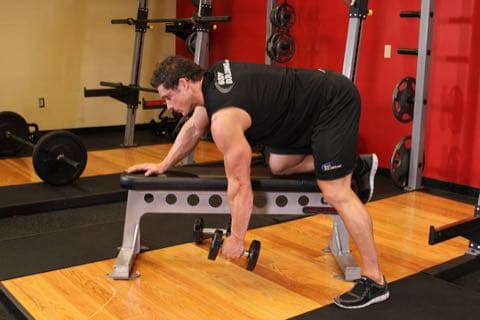
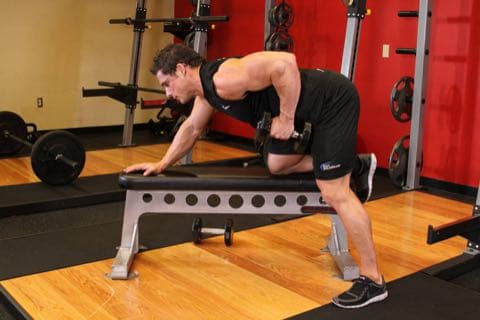
The one-arm dumbbell row trains the back, mainly the lats and the middle back, with the biceps helping. You support yourself on a bench with one hand and one knee and pull a dumbbell up with the other arm. The bench takes the strain off the lower back, so you can focus on the pull.
Updated November 2026
- Equipment
- Dumbbell
- Primary
- Middle back
- Secondary
- Biceps, Lats, Shoulders
- Level
- Beginner
How to do it
- Choose a flat bench and place a dumbbell on each side of it.
- Place the right leg on top of the end of the bench, bend your torso forward from the waist until your upper body is parallel to the floor, and place your right hand on the other end of the bench for support.
- Use the left hand to pick up the dumbbell on the floor and hold the weight while keeping your lower back straight. The palm of the hand should be facing your torso. This will be your starting position.
- Pull the resistance straight up to the side of your chest, keeping your upper arm close to your side and keeping the torso stationary. Breathe out as you perform this step. Tip: Concentrate on squeezing the back muscles once you reach the full contracted position. Also, make sure that the force is performed with the back muscles and not the arms. Finally, the upper torso should remain stationary and only the arms should move. The forearms should do no other work except for holding the dumbbell; therefore do not try to pull the dumbbell up using the forearms.
- Lower the resistance straight down to the starting position. Breathe in as you perform this step.
- Repeat the movement for the specified amount of repetitions.
- Switch sides and repeat again with the other arm.
Instructions from free-exercise-db, public domain. It is the same text the app shows on this exercise.
Saying it out loud
Any of these logs a set of one-arm dumbbell row in SayLift. Say the whole session in one go if you want, with weights, reps and sets in whatever order they come out.
You say
“”
One-arm dumbbell row
✓ Logged1You say it
2SayLift writes it
3You check and save
- “One arm dumbbell row, three sets of ten at 25”
- “Single arm dumbbell row 30 for 10, 10 and 8”
- “One arm DB row 35 three by ten”
- “One arm dumbbell row 25 for 12”
Set up on the bench
Put your left knee and left hand on a flat bench. Keep your right foot on the floor, a little out to the side. Your back should be flat and close to parallel with the floor. Hold the dumbbell in your right hand with your arm straight.
Pull the dumbbell up toward your hip, not your chest. Keep your elbow close to your body. Lower it until your arm is straight again, then switch sides after the set.
- Pull toward the hip to train the lats.
- Keep your shoulders level. Do not twist your body to lift the weight.
- Let the arm stretch fully at the bottom of each rep.
- Do the same reps on both sides.
Do not turn it into a twist
When the dumbbell is too heavy, the torso rotates to help lift it. The rep looks bigger but the back does less of the work. If your chest turns toward the ceiling at the top, drop the weight.
A short pause at the top, with the dumbbell next to your hip, is a good test. If you cannot pause, the weight is moving you.
Logging a one-arm exercise
Log the weight of one dumbbell, not both sides added together. Count the reps per side. If one side does fewer reps, write that down. It shows a gap you can work on.
Dumbbells usually go up in steps of 2 to 2.5 kg or 5 lb, which is a big jump on a row. Add reps first, then move up. With SayLift you can say "one arm dumbbell row, 25 for 10, 10 and 8" between sides.
Frequently asked questions
Should I pull to the chest or the hip?
Toward the hip, with the elbow close to the body, trains the lats most. Pulling higher, toward the chest with the elbow out, shifts work to the upper back.
How heavy should a dumbbell row be?
Heavy enough that the last reps are hard, but light enough that your torso stays still. Most people use a weight they can row for 8 to 12 clean reps per side.
Do I log one dumbbell or both sides?
Log the weight of the one dumbbell you hold and the reps for each side. That keeps the number the same as the dumbbell rack.
Stop typing between sets
Say what you lifted. SayLift writes down every set, rep and weight, then tells you what to lift next time. Say what you ate and it counts the calories too. iPhone and Android, 3 days free then $4.17 a month, billed $49.99 a year.


Reading this on a laptop? Scan to install.