Seated cable row
The seated cable row is the steady back exercise in most programmes. You sit, brace your feet, and pull a handle to your stomach. It trains the middle back and lats without the lower back having to hold a hinge, and it is the row people most often turn into a rocking motion as the stack gets heavier.
Updated September 2026
- Equipment
- Cable
- Primary
- Middle back
- Secondary
- Biceps, Lats, Shoulders
- Level
- Beginner
How to do it
- For this exercise you will need access to a low pulley row machine with a V-bar. Note: The V-bar will enable you to have a neutral grip where the palms of your hands face each other. To get into the starting position, first sit down on the machine and place your feet on the front platform or crossbar provided making sure that your knees are slightly bent and not locked.
- Lean over as you keep the natural alignment of your back and grab the V-bar handles.
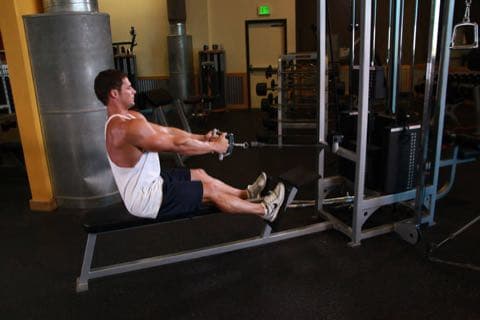
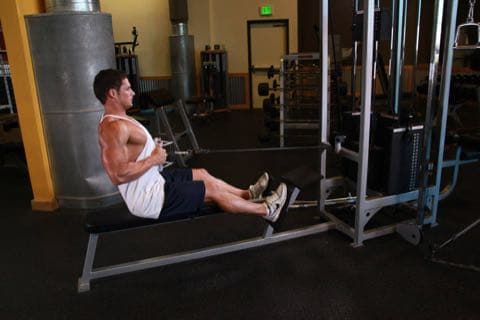
- With your arms extended pull back until your torso is at a 90-degree angle from your legs. Your back should be slightly arched and your chest should be sticking out. You should be feeling a nice stretch on your lats as you hold the bar in front of you. This is the starting position of the exercise.
- Keeping the torso stationary, pull the handles back towards your torso while keeping the arms close to it until you touch the abdominals. Breathe out as you perform that movement. At that point you should be squeezing your back muscles hard. Hold that contraction for a second and slowly go back to the original position while breathing in.
- Repeat for the recommended amount of repetitions.
Instructions from free-exercise-db, public domain — the same text the app shows on this exercise.
Saying it out loud
Any of these logs a set of seated cable row in SayLift. Say the whole session in one go if you want — weights, reps and sets in whatever order they come out.
- “Seated cable rows, three sets of twelve at 120”
- “Seated cable row 140 for 10, 10 and 8”
- “Low seated row 100, four by twelve”
How much lean is too much
Start each rep sitting tall with a slight forward reach, arms straight, and a stretch across your upper back. Pull the handle to your stomach as your torso comes back to upright, and stop there. A small lean is part of the lift.
Rocking well past upright to get the handle in is the most common way this exercise goes wrong. Your lower back swings the weight, and the back muscles you meant to train only finish the rep.
- Knees slightly bent, feet flat on the platform.
- Squeeze your shoulder blades together at the end, then let them spread on the way back.
- Chest up. Rounding over at the start and yanking back at the end is the same rock in two halves.
SayLift logs your whole workout from one spoken sentence. iPhone only, 873 exercises built in, 3 days free then $49.99 a year.
Start the free trialWhich handle to use
The close V-handle, palms facing each other, is the default and usually lets you pull the most. A wide straight bar with palms down shifts more of the work toward the upper back and rear delts. A rope sits somewhere between the two.
Each handle takes a different weight. Either note which one you used every time, or log them as separate exercises.
Logging a stack that changes between gyms
Cable stacks are not standard. Plate weights and pulley setups differ, so 140 on one machine can feel like 120 on another. Log the number on the pin and treat the history as belonging to that machine.
If you train at two gyms, keep a separate entry for each, or expect a week of finding your numbers when you switch. Log each set by voice in SayLift and the coach sets your next working weight from what you actually pulled on that stack.
Frequently asked questions
What muscles does the seated cable row work?
The middle back is the main target, with the lats, the rear shoulders and the biceps helping.
Seated cable row vs barbell row?
The barbell row makes your lower back hold a hinge for the whole set and lets you load more. The cable row is seated and braced, so it is easier to keep strict and easier to recover from. Many programmes use both, or one on each back day.
Should I lean back on seated cable rows?
A little, enough to finish upright. Leaning well past vertical means your lower back is doing the pulling. Take weight off until you can finish each rep sitting tall.
Stop typing between sets
Say what you lifted. SayLift writes down every set, rep and weight, then tells you what to lift next time. iPhone only, 3 days free then $49.99 a year.
Download on the App Store
Reading this on a laptop? Scan to install.