Pull-up
The pull-up is the one lift where the weight on the bar is you, which makes it the hardest to progress deliberately and the easiest to log wrong. Recording "pull-ups: 3 sets" tells you nothing a month later. Here is the movement, the way to build up to one, and what a useful pull-up record actually contains.
Updated September 2026
- Equipment
- Bodyweight
- Primary
- Lats
- Secondary
- Biceps, Middle back
- Level
- Beginner
How to do it
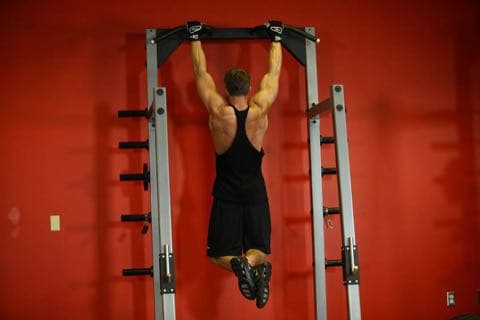
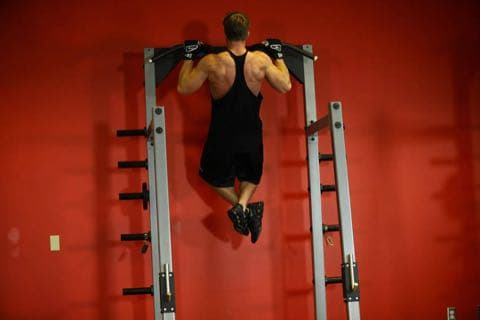
- Grab the pull-up bar with the palms facing forward using the prescribed grip. Note on grips: For a wide grip, your hands need to be spaced out at a distance wider than your shoulder width. For a medium grip, your hands need to be spaced out at a distance equal to your shoulder width and for a close grip at a distance smaller than your shoulder width.
- As you have both arms extended in front of you holding the bar at the chosen grip width, bring your torso back around 30 degrees or so while creating a curvature on your lower back and sticking your chest out. This is your starting position.
- Pull your torso up until the bar touches your upper chest by drawing the shoulders and the upper arms down and back. Exhale as you perform this portion of the movement. Tip: Concentrate on squeezing the back muscles once you reach the full contracted position. The upper torso should remain stationary as it moves through space and only the arms should move. The forearms should do no other work other than hold the bar.
- After a second on the contracted position, start to inhale and slowly lower your torso back to the starting position when your arms are fully extended and the lats are fully stretched.
- Repeat this motion for the prescribed amount of repetitions.
Instructions from free-exercise-db, public domain — the same text the app shows on this exercise.
Saying it out loud
Any of these logs a set of pull-up in SayLift. Say the whole session in one go if you want — weights, reps and sets in whatever order they come out.
- “Pull-ups, three sets of eight”
- “Pullups bodyweight 8, 6 and 5”
- “Weighted pull-ups 25 pounds for 5, 5 and 4”
- “Pull ups three sets to failure”
Getting the first one
Almost nobody gets their first pull-up by attempting pull-ups. The two things that work are negatives — jump to the top and lower yourself as slowly as you can, for three to five reps — and band-assisted or machine-assisted pull-ups with the assistance reduced over weeks.
Lat pulldowns build the same muscles and are worth doing alongside, but they do not teach the bracing, so keep some version of the hanging movement in the programme the whole way through.
SayLift logs your whole workout from one spoken sentence. iPhone only, 873 exercises built in, 3 days free then $49.99 a year.
Start the free trialLogging bodyweight work so it stays comparable
Reps per set, every set, is the minimum. "3 sets of 8" and "8, 6, 4" are very different sessions and only the second one tells you whether you are progressing.
Once you can do around ten clean reps, start adding weight and log that too. A belt with 25 lb on it is the difference between a progression that continues and a log that reads "pull-ups: 12, 12, 12" for a year.
If your bodyweight changes meaningfully, note that as well. A lifter who has gained ten pounds and is still doing ten pull-ups has got stronger, and a rep count alone will not show it.
- Full hang at the bottom, arms straight. Half reps inflate the count and train less.
- Chin over the bar, without craning the neck to get there.
- Control the descent. Dropping from the top is where most pull-up shoulder pain comes from.
Frequently asked questions
How do I get my first pull-up?
Negatives and assisted pull-ups, two or three times a week, plus lat pulldowns for volume. Most people who train the hanging movement specifically get there in one to three months.
Pull-up or chin-up?
Chin-ups (palms toward you) bring the biceps in and are usually a few reps easier; pull-ups (palms away) put more of it on the lats and upper back. Do both if you like, but log them separately.
Should I count half reps?
No. A rep starts from a full hang and ends with your chin above the bar. Counting anything else makes your own history useless as a comparison.
Stop typing between sets
Say what you lifted. SayLift writes down every set, rep and weight, then tells you what to lift next time. iPhone only, 3 days free then $49.99 a year.
Download on the App Store
Reading this on a laptop? Scan to install.