Standing calf raise
The standing calf raise trains the calves, the muscles on the back of the lower leg. You stand on the edge of a block, let your heels drop, then rise up onto your toes. It looks simple, but most people bounce through a short range and get little from it.
Updated November 2026
- Equipment
- Machine
- Primary
- Calves
- Secondary
- —
- Level
- Beginner
How to do it
- Adjust the padded lever of the calf raise machine to fit your height.
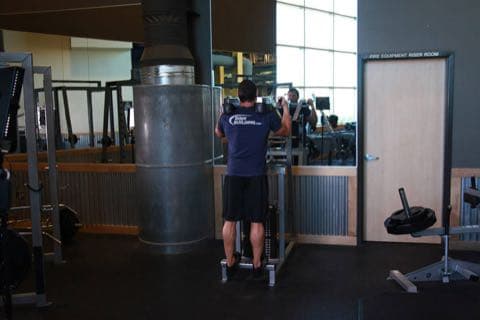
- Place your shoulders under the pads provided and position your toes facing forward (or using any of the two other positions described at the beginning of the chapter). The balls of your feet should be secured on top of the calf block with the heels extending off it. Push the lever up by extending your hips and knees until your torso is standing erect. The knees should be kept with a slight bend; never locked. Toes should be facing forward, outwards or inwards as described at the beginning of the chapter. This will be your starting position.
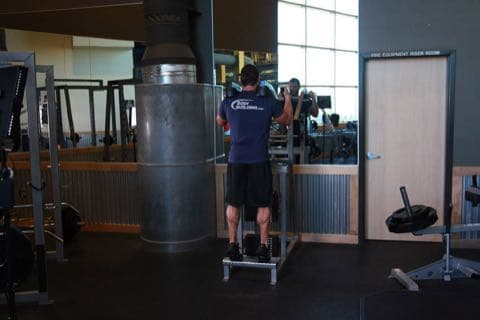
- Raise your heels as you breathe out by extending your ankles as high as possible and flexing your calf. Ensure that the knee is kept stationary at all times. There should be no bending at any time. Hold the contracted position by a second before you start to go back down.
- Go back slowly to the starting position as you breathe in by lowering your heels as you bend the ankles until calves are stretched.
- Repeat for the recommended amount of repetitions.
Instructions from free-exercise-db, public domain. It is the same text the app shows on this exercise.
Saying it out loud
Any of these logs a set of standing calf raise in SayLift. Say the whole session in one go if you want, with weights, reps and sets in whatever order they come out.
You say
“”
Standing calf raise
✓ Logged1You say it
2SayLift writes it
3You check and save
- “Standing calf raises, three sets of fifteen at 60”
- “Standing calf raise 80 for 12, 12 and 10”
- “Standing calf raises 70 three by fifteen”
- “Standing calf raise 90 for 12”
Use the full range
Stand with the balls of your feet on the edge of the block and your heels hanging off. Keep your knees straight but not locked. Lower your heels as far as they go, then rise up as high as you can onto your toes.
The bottom stretch is the most useful part of the rep. Pause there for a moment before you push up. Then pause again at the top.
- Pause one second at the bottom to stop the bounce.
- Pause one second at the top and squeeze.
- Keep your knees straight to train the upper calf.
- Push through the big toe, not the outside of the foot.
Slow beats heavy
Your Achilles tendon acts like a spring. Fast reps bounce off that spring, so the calf muscle does less. Slow reps with pauses feel much harder at the same weight.
If you load a lot of weight and only move a few centimeters, lower the weight and use the full range.
Logging calf work
Calf raise machines differ between gyms, and some use a shoulder pad while others use a belt or the Smith machine. Log the number you use and treat it as tied to that machine.
Calves often get trained at the end of a session, when it is easy to forget the numbers. With SayLift you can say "standing calf raise, 60 for 15, 15 and 12" before you walk to the next machine.
Frequently asked questions
How many reps for calf raises?
Most people use 10 to 20 reps. The key is a full range with a pause at the bottom, not the exact number.
Standing or seated calf raise?
Standing with straight knees trains the larger upper calf muscle more. Seated with bent knees trains the lower, deeper calf muscle more. Many routines use both.
Can I do calf raises without a machine?
Yes. Stand on a step and hold a dumbbell in one hand, or use your body weight. Log it as a separate exercise from the machine version.
Stop typing between sets
Say what you lifted. SayLift writes down every set, rep and weight, then tells you what to lift next time. Say what you ate and it counts the calories too. iPhone and Android, 3 days free then $4.17 a month, billed $49.99 a year.


Reading this on a laptop? Scan to install.